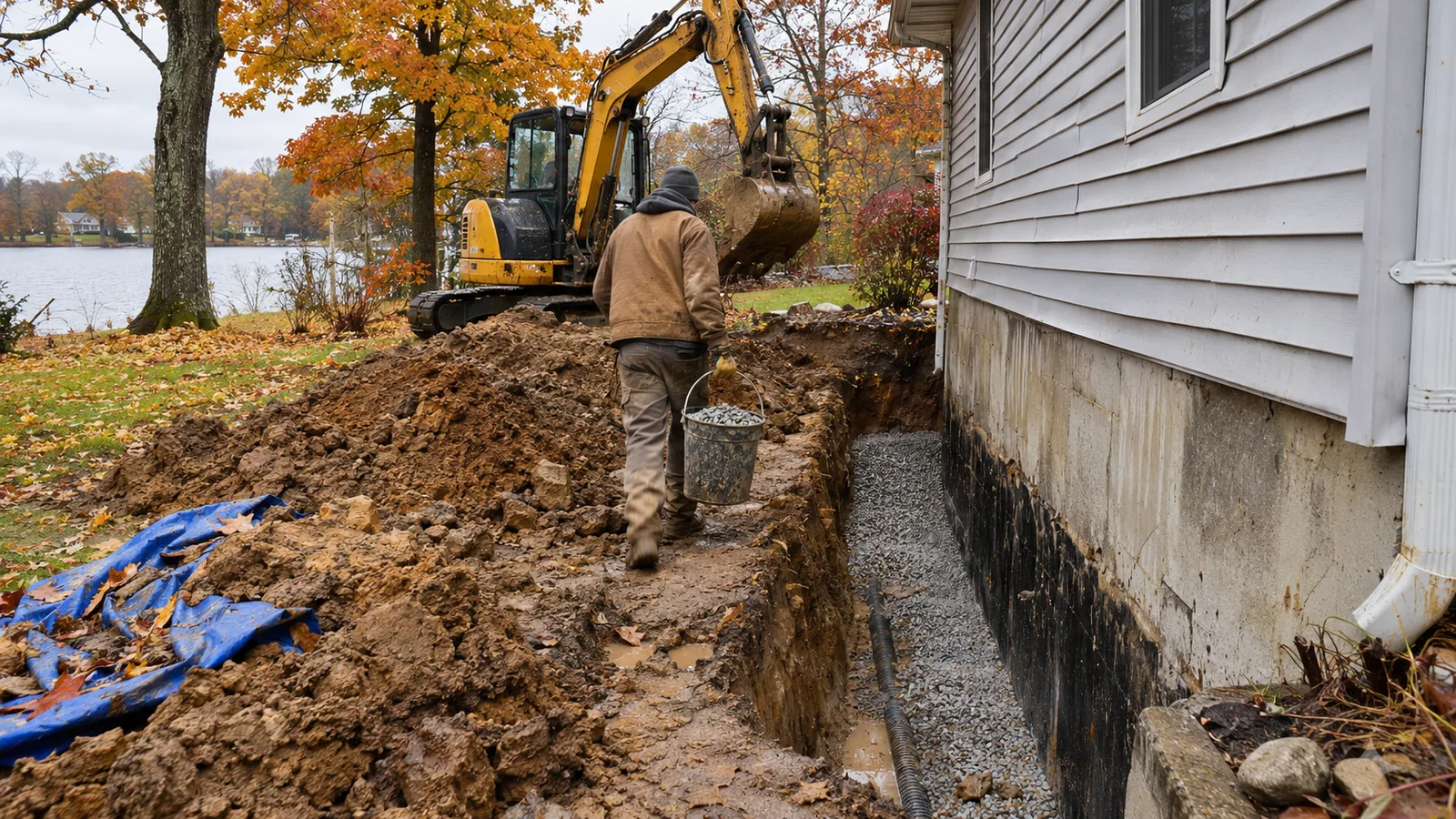
Trumbull County Freeze-Thaw: Why Your Basement Cracks Every Winter
Trumbull County freeze-thaw is the single biggest driver of poured-wall basement cracks in Cortland, Warren, and Niles. Here is why it happens, what the real fix costs, and when a $12 tube of hydraulic cement is enough.
Published · By Matthew Stepanovich
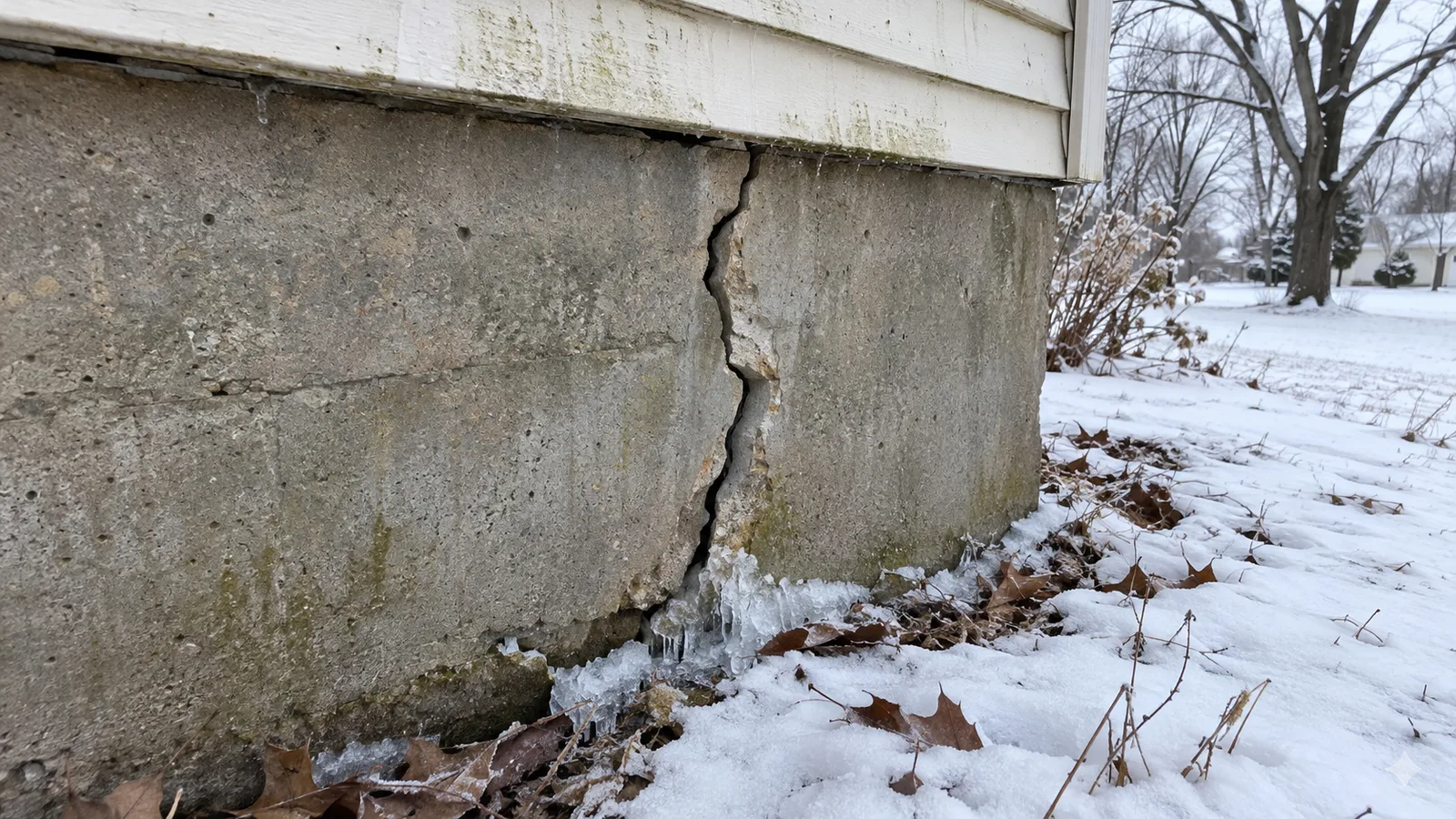
Trumbull County basements crack in winter because water in the backfill soil freezes against the outside of the foundation wall, expands by about 9 percent in volume, and pushes inward with enough pressure to split a poured concrete wall at its weakest point. The weakest point is almost always a tie-rod rust spot about 3 feet off the floor on a 1970s, 1980s, or 1990s poured wall. The crack opens between November and March, leaks the following April and May when the ground thaws, and comes back a little worse every winter until it gets a proper polyurethane injection at $350 to $1,200. If your Cortland or Warren basement cracks a little more every spring, this is why.
What is freeze-thaw and why is Trumbull County worse than most of Ohio?
Freeze-thaw is the repeated cycle of water in soil freezing solid, expanding, and then melting back. Every time the temperature drops below 32°F and then rises above it, the soil around your foundation goes through one freeze-thaw cycle. In Trumbull County, the number of cycles per winter is higher than the Ohio average because the county sits in the snow-belt plume off Lake Erie, pulling 70 to 90 inches of snow a year and holding the ground frozen for long stretches of January and February before thawing sharply in March.
The expanding ice does not just push straight at the wall. It does something more damaging called lensing, where ice forms in horizontal layers in the clay and lifts the backfill vertically. On a 7 to 10 foot deep Cortland basement wall, the frost line can reach 36 to 48 inches below grade in a cold February, and the lensing pressure translates into a lateral push against the top third of the wall at roughly 1,500 to 2,500 pounds per square foot. That is why cracks almost always start in the top third of the wall, not near the footer where the backfill is warmer.
Why do tie-rod rust spots split first?
When a Cortland home was poured in the 1970s, 1980s, or 1990s, the concrete forms were held together with steel tie rods every 4 to 6 feet across the wall. After the pour cured, the ends of the rods were snapped off flush with the wall surface, and the stub was left buried in the concrete. Steel rusts, and rusting steel expands to as much as 7 times its original volume. Over 10 to 15 years, that 3/8 inch rod stub rusts and swells, pre-loading a stress riser in the wall right at the stub. When the next freeze-thaw cycle hits, the wall splits exactly at the rust spot, which is why Cortland cracks run vertically and sit roughly 3 feet off the floor.
You can usually see the rust bloom on the inside of the wall if you look closely, a small brown stain spreading out from a point about 3 feet up the wall. The crack above and below it is the clue.
What does a freeze-thaw crack look like in a Cortland basement?
The classic Trumbull County crack has four signatures. It runs vertically, usually 24 to 48 inches long. It is widest at the tie-rod rust spot and tapers at top and bottom. It leaks in April and May when the backfill thaws but is dry in July and August when the soil is drained. And it is wider at the inside face of the wall than at the outside, which tells you the crack is being driven by inward backfill pressure, not by wall settlement.
If your crack runs horizontally across the wall instead of vertically, or if the wall is bowed inward more than 1 inch from vertical, you have a different problem and it is a structural one. Horizontal cracks mean the wall is failing in bending from excessive lateral load, usually from wet expansive clay that never drained. That is not a crack injection job, that is a carbon-fiber strap job at $500 to $800 per strap, usually 3 to 5 straps on the wall, or in bad cases a full excavation and straightening at $15,000 to $30,000.
What does the permanent fix cost in Cortland?
For a typical freeze-thaw vertical crack on a Cortland poured wall, the permanent fix is polyurethane crack injection at $350 to $1,200 per crack. Here is what you are paying for. We drill surface ports at 8 inch spacing along the full length of the crack. We inject low-viscosity polyurethane resin at 150 to 250 PSI through each port, working port-by-port from the bottom up until resin visibly exits the port above. The polyurethane expands as it reacts with moisture in the crack, fills the full thickness of the wall, and bonds to both faces. Once cured, usually in 2 to 4 hours, the crack is permanently sealed and the polyurethane stays flexible enough to handle the next freeze cycle.
Polyurethane is the right chemistry 90 percent of the time on Cortland cracks because it is flexible. Epoxy injection at $600 to $1,500 per crack is rigid and is only the right call when the crack is also carrying structural load, which is uncommon on freeze-thaw cracks. A contractor who quotes you epoxy on every job is either confused or upselling.
When can you DIY a basement crack?
Honestly, sometimes. If the crack is dry, hairline, under 6 feet long, and not leaking during any season, a tube of hydraulic cement or a DIY polyurethane injection kit from a hardware store at $40 to $150 will get you another 5 to 10 years cosmetically. The DIY kit does not fill the full wall thickness the way a 250 PSI professional injection does, but if the crack is dry you are not solving a leak, you are managing cosmetics. That is a real homeowner savings on the right crack.
Call a crew when the crack is actively leaking during rain, when it is wider than 1/8 inch, when it is longer than 8 feet, when the wall is bowed, when you see a horizontal crack at any width, or when you see multiple parallel vertical cracks on the same wall. These are the signs that the wall is either actively moving or the water load is beyond what a DIY tube can handle. Our full polyurethane injection with ports, pressure pump, and cure test is the right fix at $350 to $1,200 per crack and we warranty the install in writing.
How to slow down the next crack before it starts
Four prevention moves that cost under $300 total. Extend your downspout extensions to 6 to 10 feet from the foundation, which keeps roof runoff out of the backfill zone that freezes in January. Grade the soil away from the foundation at 1 inch of drop per foot for the first 6 feet, which drains surface water off the wall before it can soak in. Clear snow drifts off the exterior wall base in January and February, which cuts the mass of ice forming against the wall. And check your sump pump every October before the first freeze, swap any pump older than 7 years, and add a battery backup at $450 to $1,100 if you do not have one. These four moves cost less than $300 and buy you years before the next crack opens.
If you live in Cortland, Warren, Niles, or any of the surrounding Trumbull County towns we work and you see a new crack this winter or a leak this spring, call us for a same-day on-site inspection. We will tell you honestly whether it is a DIY tube of hydraulic cement, a $500 injection job, or a $12,000 interior drain system, and we will put the real answer in writing before any work starts.