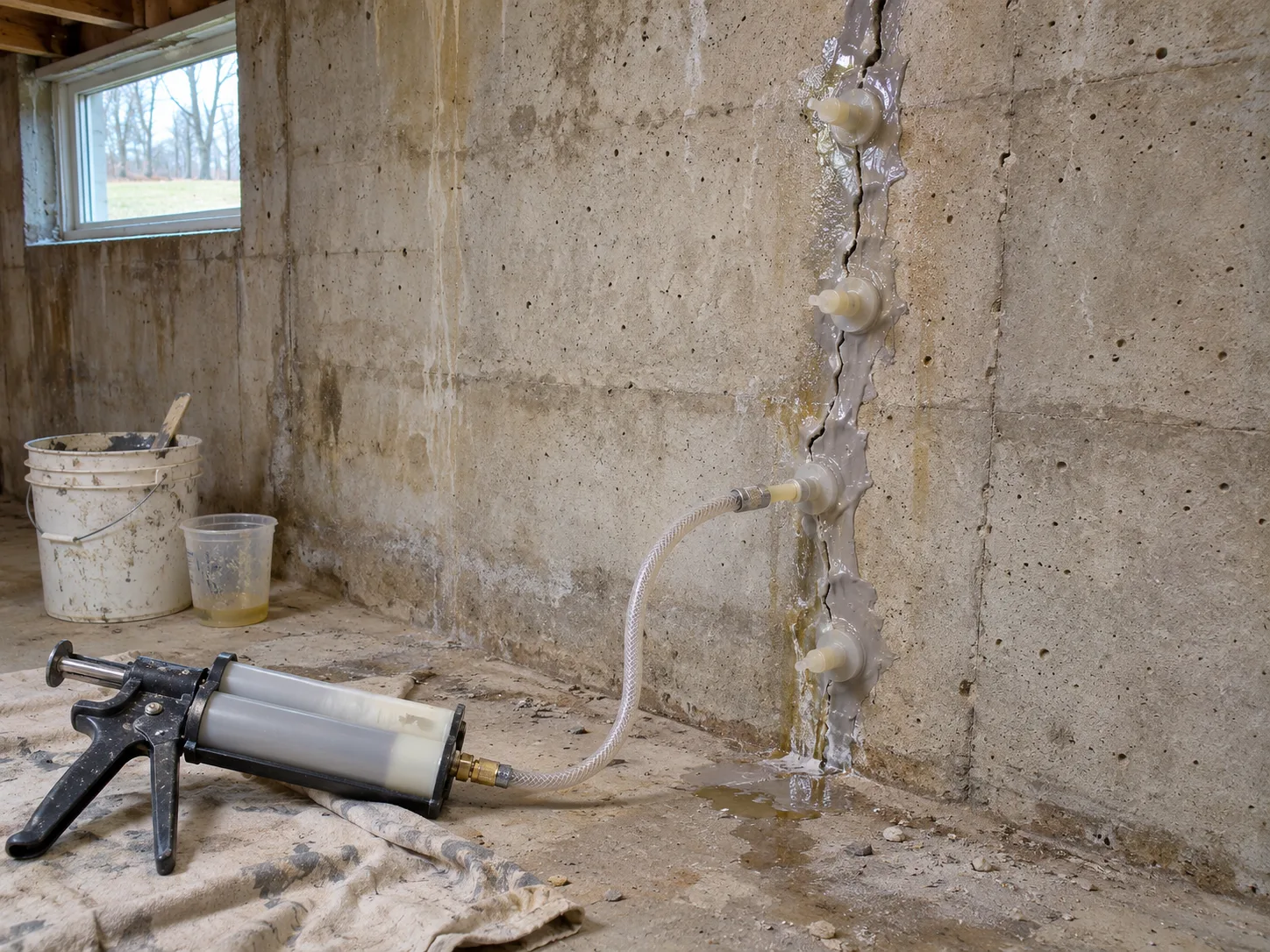
The vast majority of poured-wall foundation cracks in Cortland start at a tie-rod rust spot, run vertical, and show up between years 8 and 15 of the home's life. Trumbull County freeze-thaw is the driver. Water soaks the backfill in November, freezes in December, pushes against the wall as it expands, and the wall splits at the weakest cross-section, usually at the tie-rod hole where a thin metal rod is still buried in the concrete. On 1980s and 1990s builds off State Route 46 and the Mecca Street corridor, these are the single most common failure mode we repair.
The correct fix is low-viscosity polyurethane injection from the inside, pumped through surface ports at 150 to 250 PSI so the resin fills the full thickness of the wall and bonds to both faces. Polyurethane expands as it reacts with moisture, which is the point, it chases the water, seals around any rebar, and stays flexible enough to handle the next freeze cycle. Epoxy injection is the right call on a structural crack that is also carrying load, because epoxy is rigid and restores the compressive strength of the original pour. We pick the chemistry based on the crack, not the invoice.
On block foundation homes, which is most of the pre-1970 housing stock around downtown High Street and the older sections of Warren and Niles we cover, the cracks look different. Block cracks follow the mortar joints in a stair-step pattern and the water comes in through the hollow cores, not through the crack itself. The fix is weep hole drilling into every core at the slab line, tie-in to an interior drain, and tuckpointing the surface mortar for cosmetics. Injecting a block crack with polyurethane is a waste of money, the water just runs around the injection through the next joint.
Carbon-fiber strapping is the right fix on bowed walls past 1 inch of deflection, usually caused by expansive clay backfill pushing against the wall over years of freeze-thaw. We epoxy 12 inch wide carbon straps vertically every 4 feet along the inside of the wall, keyed into the footer and the sill plate. This stops further movement without excavating the outside. A wall past 2 inches of bow needs full excavation and wall straightening, which is a different scope and a different conversation.
What we handle
Polyurethane Crack Injection
Low-viscosity polyurethane injected through surface ports at 150 to 250 PSI, fills the full wall thickness, stays flexible through freeze-thaw cycles. The right chemistry for the 90 percent of Cortland poured-wall cracks that are seepage cracks, not structural.
Epoxy Structural Crack Injection
Rigid structural epoxy for cracks that are carrying load, usually on poured walls where the crack is wider than 1/8 inch and the wall is also bowed. Restores the compressive strength of the original concrete pour.
Emergency Active-Leak Crack Repair
Same-day response for cracks that are actively leaking during a storm. We stop the water with a hydraulic plug, then come back dry to do the permanent polyurethane injection once the crack is no longer wet.
Carbon-Fiber Wall Reinforcement
12 inch wide carbon-fiber straps epoxied vertically every 4 feet on bowed poured walls under 2 inches of deflection. Stops further inward movement without excavating the outside backfill.
Block Foundation Crack and Joint Repair
Weep hole drilling into every CMU block core at the slab line, tie-in to an interior drain system, and tuckpointing the surface mortar. The right scope for block foundations where water runs inside the wall, not through the crack.
Slab Crack Sealing
Polyurea slab injection on cracked basement and garage floors to stop radon and water migration through the slab. Finishes in a single visit. Not a structural repair, a moisture and gas seal.
How the job goes
1. Phone Intake and Crack Count
You call, tell us how many cracks you see, how wide they are, where they show up on the wall, and whether they leak during rain. We give you a per-crack price band and schedule an on-site look, usually the same day if before 2 PM.
2. On-Site Inspection
Owner or tech walks every wall, maps every crack, measures width with a crack gauge and depth with an awl. We check for bowing with a 4 foot level and look for related cove-joint seepage. Full map takes 30 to 60 minutes.
3. Written Per-Crack Quote
You see a line-item quote with each crack numbered, chemistry picked, and price locked. Simple cracks can start the same visit if parts are on the truck. Multi-crack jobs get scheduled, usually inside 1 week.
4. Injection and Cure Test
Surface ports installed at 8 inch spacing, port-by-port injection from the bottom up until resin visibly exits the port above, caps installed and surface ground flush. Each crack cures in 2 to 4 hours before we spray-test it with a garden hose on the outside wall.
What's included
- Full wall-by-wall crack map with widths and lengths in writing
- Chemistry selected per crack (polyurethane, epoxy, hydraulic)
- Surface ports and caps installed and ground flush with the wall
- Garden-hose spray test on the outside after cure
- Transferable written warranty on every crack we inject
- Photos of before, during, and after injection emailed same day
What it costs
Most single-crack polyurethane injections in Cortland run $350 to $1,200 per crack. Carbon-fiber wall reinforcement runs $500 to $800 per strap installed. Block-wall weep hole drilling runs $350 to $650 per wall.
| Job | Typical price | Notes |
|---|---|---|
| On-Site Crack Inspection and Written Quote | Free | Standard residential homes in Cortland and the 8 surrounding towns we cover. Multi-crack jobs get a line-item written quote on the spot. |
| Polyurethane Injection (Per Crack) | $350 to $1,200 | Low end for a single hairline crack under 6 feet long. Higher end for wider cracks, longer runs, or cracks that are actively leaking during injection. |
| Epoxy Structural Injection (Per Crack) | $600 to $1,500 | Rigid structural epoxy for load-bearing cracks on poured walls. Higher material cost than polyurethane, and the wall has to be dry at injection. |
| Carbon-Fiber Strap (Per Strap Installed) | $500 to $800 | 12 inch wide strap epoxied vertically on inside face. Typical bowed wall needs 3 to 5 straps. Price locks on the walk. |
| Block Wall Weep Hole Drilling (Per Wall) | $350 to $650 | Drills into every CMU core at slab line, tied to interior drain. Priced per wall of block, not per core. |
| Slab Crack Polyurea Injection | $250 to $750 | Per crack. Seals slab cracks against radon and water migration. Not a structural repair. |
Ranges are typical for Foundation Crack Repair jobs in Cortland and confirmed with an exact written quote before any work starts.