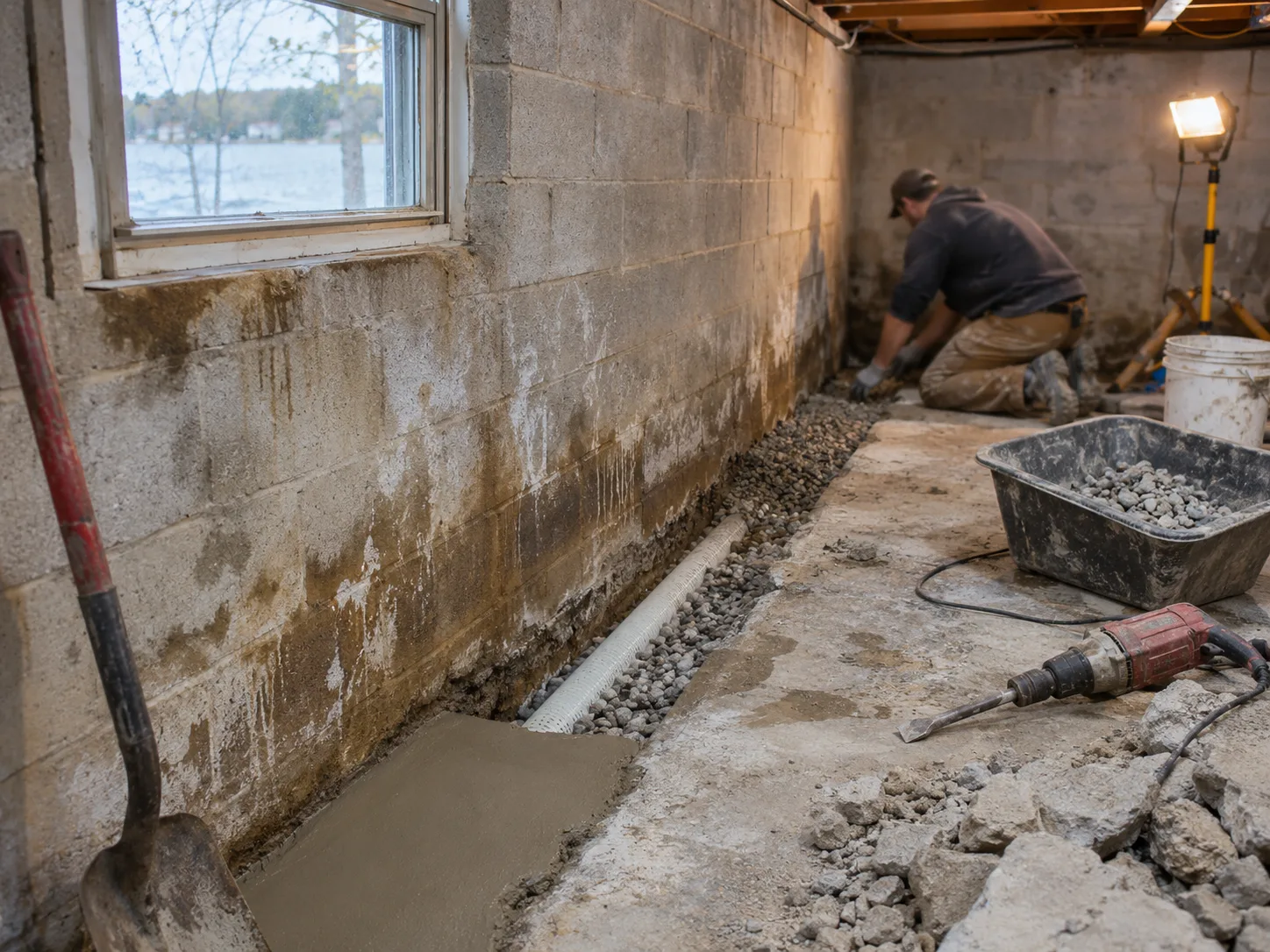
Most wet basement calls in Cortland fall into four buckets: cove-joint seepage where the wall meets the slab, vertical hairline cracks in poured walls, block-wall seepage through mortar joints, and full hydrostatic flooding from a high water table. On a 1960s or 1970s poured-wall home off Mahoning Avenue, a single vertical crack under a tie-rod rust spot is usually a $350 to $1,200 polyurethane injection job. On 1980s block foundations around the Lakeshore Drive corridor, the cove joint is almost always the villain, and that one gets a full interior drain tile with a new 1/3 HP cast-iron sump at the $4,500 to $12,000 range.
Trumbull County glacial till is where we see the toughest basements in the region. The clay-heavy soils around Mosquito Creek Lake watershed hold water for days after a 1 inch rain, so hydrostatic pressure against the wall stays high long after the rain stops. We size interior drain pipe at 4 inch perforated with a filter sock in a proper stone trench, not the 3 inch flex pipe you see in big-box DIY videos, and we set sump pits 18 to 24 inches below slab so the pit holds enough water to run the pump on a real cycle instead of short-cycling itself to an early death.
Winter here runs teens to 20s from December through February and the snow-belt lake-effect off Lake Erie piles up fast. That freeze-thaw cycle is the single biggest wall-crack driver in Cortland. Water soaks the backfill in November, freezes in December, pushes against the wall as it expands, and cracks poured concrete at the weakest point, usually at the tie-rod holes or at the top of the wall where the backfill sits highest. We inject these cracks from the inside with low-viscosity polyurethane that expands and fills the full depth of the wall, not surface-level hydraulic cement that pops back out by spring.
The mistake we see most from cheap contractors in Cortland is sealing cove joints with paint and calling it waterproofing. DryLok on a wet wall is a 6-month fix at best, and once hydrostatic pressure builds behind it, the paint delaminates and you are back where you started with a wall that is now harder to properly drain. The honest answer on chronic basement water is a positive drainage system, not a coating. We will tell you straight on-site which one you need, and if a $500 crack injection fixes it, that is what we quote.
What we handle
Interior Drain Tile and Sump Installation
Full perimeter interior drain tile with new 1/3 HP cast-iron sump and battery backup. 4 inch perforated pipe in clean stone, pit set 18 to 24 inches below slab. Typical 3 to 4 day install for a 1,000 to 1,500 square foot basement.
Emergency Wet Basement Response
Same-day response for active flooding, failed sumps, and water coming in during a storm. We bring portable pumps, patch the inflow, and give you a stabilization plan while a permanent scope gets built.
Exterior Excavation Waterproofing
Full dig to the footer, old parging and tar stripped, new dimple membrane and rubberized asphalt coating applied, drain tile at the footer tied to daylight or sump. The right fix when the outside wall is the real failure, not the inside.
Cove-Joint and Wall-Crack Sealing
Polyurethane crack injection on poured walls at the tie-rod rust lines and vertical cold joints. Low-viscosity resin that fills the full wall thickness, not surface-level hydraulic cement that pops out by spring.
Block Foundation Waterproofing
Weep hole drilling at every core on CMU block foundations plus interior drain tile, so water inside the blocks has a path to the sump instead of pushing out through mortar joints onto your slab.
Sump Pump Battery Backup and Alarm
AGM battery backup plus water-level alarm on existing sump pits, so a power outage during a Cortland spring storm does not become a flooded basement at 2 AM.
Commercial and Multi-Family Waterproofing
Light commercial basements, rental duplexes, and small multi-family in Warren and Niles. Drain tile systems sized for higher occupancy and larger-capacity sumps where code and insurance require it.
Window Well and Egress Drainage
Window well repair with new gravel base, drain tie-in to the perimeter system, and new covers. Stops the number one single-point leak in 1970s and 1980s Cortland basements with ground-level wells.
How the job goes
1. Phone Intake and Price Band
You call, we ask 4 or 5 quick questions, age of the home, foundation type, where the water shows up, how long, existing sump or not. You get a likely cause, a price band, and an arrival window. Most same-day inspections get a 3-hour window.
2. On-Site Inspection
Owner or lead tech on-site with moisture meter and flashlight. We walk every wall, check cove joints, read crack patterns, measure sump pit depth and check discharge run. Full inspection runs 45 to 75 minutes and ends with a plain cause.
3. Written Quote by End of Day
You see the quote on paper or email before the end of the day. Scope, trench footage, materials by brand, warranty terms, and the real number all in writing. Permit paperwork handled by us on jobs that need it.
4. Install, Flood Test, Cleanup
Crew arrives on the scheduled day, drop cloths and plastic over your belongings, jackhammers only what is needed, installs drain tile and sump, pours fresh concrete. Full garden-hose flood test before pack-out. Shop vac over the floor, old sump hauled off.
5. Photos, Warranty, Follow-Up
Install photos of trench, drain pipe in stone, sump pit, and discharge line emailed to you the day we pack out. Written transferable warranty in your hand. We call back at 30 days and after the first heavy rain to confirm the system is dry.
What's included
- On-site inspection with moisture meter and written cause report
- Written flat-rate quote before any concrete gets cut
- 4 inch perforated drain tile in clean stone with filter sock
- New cast-iron 1/3 HP sump pump with vertical float switch
- Fresh concrete patch over trench, finished flush with existing slab
- Full garden-hose flood test before crew packs out
- Install photos of trench, pit, and discharge line emailed day of pack-out
- Transferable written workmanship warranty
- 30-day and first-heavy-rain call back
What it costs
Most interior drain tile and sump systems in Cortland run $4,500 to $12,000 all-in. Wall-crack injections sit at $350 to $1,200 each. Exterior excavation pushes $10,000 to $25,000 depending on depth and access.
| Job | Typical price | Notes |
|---|---|---|
| On-Site Inspection and Written Quote | Free | Standard residential homes in Cortland and the 8 towns we cover. Commercial and out-of-area carry a small drive-and-diagnose fee that rolls into the job if hired. |
| Wall Crack Injection (Poured Wall) | $350 to $1,200 | Per crack. Low end for a single hairline injection. Higher end for cracks longer than 6 feet or with active flow during injection. |
| Sump Pump Install or Swap | $600 to $2,200 | Low end for a straight pump swap in an existing pit. Higher end for new pit cut into slab, cast-iron pump, and battery backup. |
| Interior Drain Tile and Sump System | $4,500 to $12,000 | Typical 1,000 to 1,500 square foot basement. Price moves on trench footage, pit count, discharge run length, and whether a block foundation needs weep holes drilled. |
| Exterior Excavation Waterproofing | $10,000 to $25,000 | Full dig to the footer with new dimple membrane, rubberized coating, and footer drain. Price moves hard on depth, access, and whether landscaping or a deck has to come out. |
| Battery Backup and Water Alarm on Existing Sump | $450 to $1,100 | AGM battery backup with water-level alarm added to an existing pit and pump. Prevents 2 AM floods during a Cortland power outage. |
Ranges are typical for Basement Waterproofing jobs in Cortland and confirmed with an exact written quote before any work starts.